- The Quantum State
- Posts
- The Quantum State – December 2025
The Quantum State – December 2025
A monthly newsletter by BTQ Technologies
The White House issued an Executive Order launching the Genesis Mission, a Department of Energy-led national initiative to boost U.S. scientific and technological leadership through artificial intelligence and quantum computing.”
November saw quantum technology shift decisively from research to industrial deployment across policy, infrastructure, and commercial ecosystems. The White House launched the Genesis Mission, a Department of Energy–led national initiative anchoring U.S. leadership in AI and quantum.
At the same time, governments and supercomputing centers worldwide accelerated investment: Japan earmarked nearly $900M for quantum and deep tech, DOE renewed $625M for its National QIS Centers, and NVIDIA’s NVQLink became the de facto standard for hybrid quantum–classical integration across leading scientific labs.
On the commercial side, November demonstrated clear momentum toward scalable, hybrid, and application-driven quantum systems. BTQ deepened its shift to a fully integrated neutral-atom company through the acquisition of QPerfect, whose MIMIQ and QLU tools tackle core bottlenecks in simulation and error correction. Major upgrades to GPU-accelerated emulators, new photonic and analog compute processors, national-scale deployments (Saudi Arabia’s first quantum computer), and DARPA’s progression to Stage B of QBI all point toward accelerating timelines for utility-grade quantum capabilities.
November showed the pivot from “quantum R&D” to “quantum infrastructure,” where real systems, real budgets, and real applications begin to converge.

BTQ Exercises Option to Acquire QPerfect, a Leading Neutral Atom Computing Company, Strengthening BTQ as a Fully Integrated Quantum Company
BTQ has exercised options to acquire QPerfect by announcing that it is making a strategic investment of approximately 2 million Euros for a minority stake in QPerfect. This move establishes BTQ as the first listed fully integrated neutral atom quantum technology company.
QPerfect’s MIMIQ emulator and Quantum Logical Unit (QLU) addresses two of the most critical bottlenecks in quantum computing, which when integrated into BTQ’s cryptographic platform will speed up the design, testing, and rollout of post-quantum security, one-shot signature, and applications for finance, communications, and critical infrastructures.
This partnership supports BTQ’s transition from a research-focused company to an industrial-scale solutions provider in neutral atom computing and post-quantum security, with defensible IP and scalable commercialization rights.

BTQ Technologies QPerfect division has launched a major upgrade to the QLEO quantum emulator in partnership with French quantum microelectronics company Quobly. Announced at the Supercomputing Conference (SC25), the new release integrates GPU acceleration through NVIDIA’s cuQuantum SDK and adds full CUDA-Q compatibility. This upgrade, powered by QPerfect’s MIMIQ engine, delivers up to 100× faster simulations than CPU-only approaches and allows developers to write CUDA-Q circuits and run them directly on QLEO without any code changes.
The update also positions QLEO to be deployed broadly across existing GPU infrastructure, giving researchers and developers seamless access to NVIDIA-accelerated environments in both cloud and on-premise systems. The new version of QLEO is already available on OVHcloud’s Quantum Platform and can be installed locally via pip.
Quantum Infrastructure & Investment
 Japan Channels Almost $900 Million Into Quantum PushJapan plans to allocate about ¥400 billion ($2.6 billion) in a supplementary budget to advance quantum technology, artificial intelligence, and nuclear fusion, according to Japan News. About ¥130 billion ($855 million) will directly support quantum research, including new R&D bases at AIST and enhanced collaboration among domestic hubs. |  DOE Announces $625 Million to Advance National Quantum Information Science Research CentersThe U.S. Department of Energy (DOE) announced $625 million in renewed funding to support advancements in quantum computing, networking, and sensing for its five National Quantum Information Science (QIS) Research Centers, which were originally established under the 2018 National Quantum Initiative Act. |
 IQM to Invest Over €40 Million to Expand Finland Production FacilityIQM Quantum Computers has announced plans to invest over €40 million in expanding its state-of-the-art production facility in Finland, boosting cleanroom capacity, quantum data center infrastructure, and assembly lines to support the fabrication of advanced superconducting quantum processors and full-stack systems. |  Firgun Ventures Launches $250 Million VC Fund to Invest in Quantum, Announces First $70 Million CloseFirgun Ventures has announced a first close of $70 million to launch what it calls the market’s first VC fund focused on early growth-stage quantum technology companies, backed by the Qatar Investment Authority. The fund, with a target of $250 million, will invest globally in quantum computing, sensing, and communications. |
Quantum in Industry
Supercomputing Centers to Integrate Quantum Processors Using NVIDIA’s NVQLink
On November 17, 2025, NVIDIA announced that the world’s leading scientific computing centers are adopting NVIDIA’s NVQLink, a first-of-its-kind, universal interconnect for linking quantum processors with state-of-the-art accelerated computing.
More than a dozen supercomputing centers and national research institutions across the U.S., Europe, and Asia are integrating NVIDIA’s NVQLink into their workflows.
Tapping the low latency and high throughput of this interconnect advances the ability of these centers and institutions to research, develop, and harness the integration of quantum-classical hardware.
NVQLink allows the coupling of quantum processors and GPUs through tight integration with quantum control systems and GPU supercomputing within the NVIDIA CUDA-Q software platform.
Quantinuum has carried out the world’s first real-time use of a scalable decoder for a class of quantum error correction known as qLDPC. Quantinuum used NVQLink with its Helios processor to demonstrate real-time decoding for quantum error correction, exceeding performance requirements by a wide margin. Pivotal to achieving this result was NVQLink’s ability to provide a flexible and configurable decoder capable of massive parallelism.
DARPA Advances Quantum Computing Initiative
The Defense Advanced Research Projects Agency (DARPA) has advanced to the next phase (Stage B) of its flagship quantum computing program, Quantum Benchmarking Initiative (QBI), marking a shift from conceptual review to rigorous technical validation of utility-scale quantum computing architectures. A total of 11 quantum-based companies have moved into Stage B.
QBI is not a competition to constrain the field to an ultimate winner, or set of “winners.” Rather, the initiative aims to assess and demonstrate a path to the development of an industrially useful quantum computer – one whose computational value exceeds its cost – within the next eight years, that is, by 2033.
Quantum Computing Breakthroughs
 IonQ and Heven AeroTech Partner to Develop Quantum-Enabled Drones for National Security ApplicationsOn November 25, 2025, IonQ announced a new investment and strategic partnership with Heven AeroTech, a developer of advanced hydrogen-powered Unmanned Aerial System (UAS) solutions for defense and aerospace missions, to integrate quantum computing, networking, sensing, and security technologies into hydrogen-powered autonomous drones. |  AI-Quantum Research for Fault Detection Wins 2025 HPC Innovation AwardSynergistic AI-quantum research by SiC Systems, ORCA Computing, Novo Nordisk, and the Technical University of Denmark has won the world’s most prestigious 2025 High Performance Computing (HPC) Innovation Excellence Award for research combining artificial intelligence (AI) and quantum computing to detect manufacturing faults. |
 Q.ANT Releases New Photonic Processor for AI and HPCQ.ANT has released its next-generation Native Processing Unit, the Q.ANT NPU 2. By replacing transistor logic (found in a CMOS chip) with native analog, light-based computation, Q.ANT’s new processor delivers up to 30x lower energy use and 50x higher performance for complex AI and HPC workloads. |  NVIDIA and RIKEN Deploy New Supercomputers for AI and Quantum ResearchNVIDIA has announced that RIKEN, Japan’s leading national research institute, is integrating NVIDIA’s GB200 NLV4 systems with two new supercomputers in Japan designed for AI research and quantum computing. While the AI-focused system uses 1,600 NVIDIA Blackwell GPUs, the quantum-oriented system uses 540 GPUs, with both connected through NVIDIA Quantum-X800 InfiniBand. |
Saudi Arabia Deploys Its First Quantum Computer with Aramco-Pasqal Partnership
Aramco, one of the world’s leading integrated energy and chemicals companies, has partnered with Pasqal for the successful deployment of Saudi Arabia’s first quantum computer dedicated to industrial applications.
The 200-qubit neutral-atom Pasqal quantum computer is installed at Aramco’s data center, in Dhahran, to support various quantum applications across energy, materials, and industrial sectors in the Kingdom of Saudi Arabia and the wider Middle East.
As part of the partnership, Pasqal will provide talent development and joint research opportunities for Saudi engineers and scientists and oversee the localization of quantum technologies to bolster Saudi Arabia’s emerging quantum ecosystem.
Quantum Security & Blockchain
 Quantum Computers Could be Powerful Enough to Crack Bitcoin a Few Years After 2030, CEO of Nvidia’s Quantum Partner SaysQuantum computers should be powerful enough a few years after 2030 to crack Bitcoin’s security properties by instantly solving its mining mechanism or guessing wallet passwords using brute force, says Théau Peronnin, the CEO of Alice & Bob, a VC-backed company working in partnership with Nvidia on developing a fault-tolerant quantum computer. | 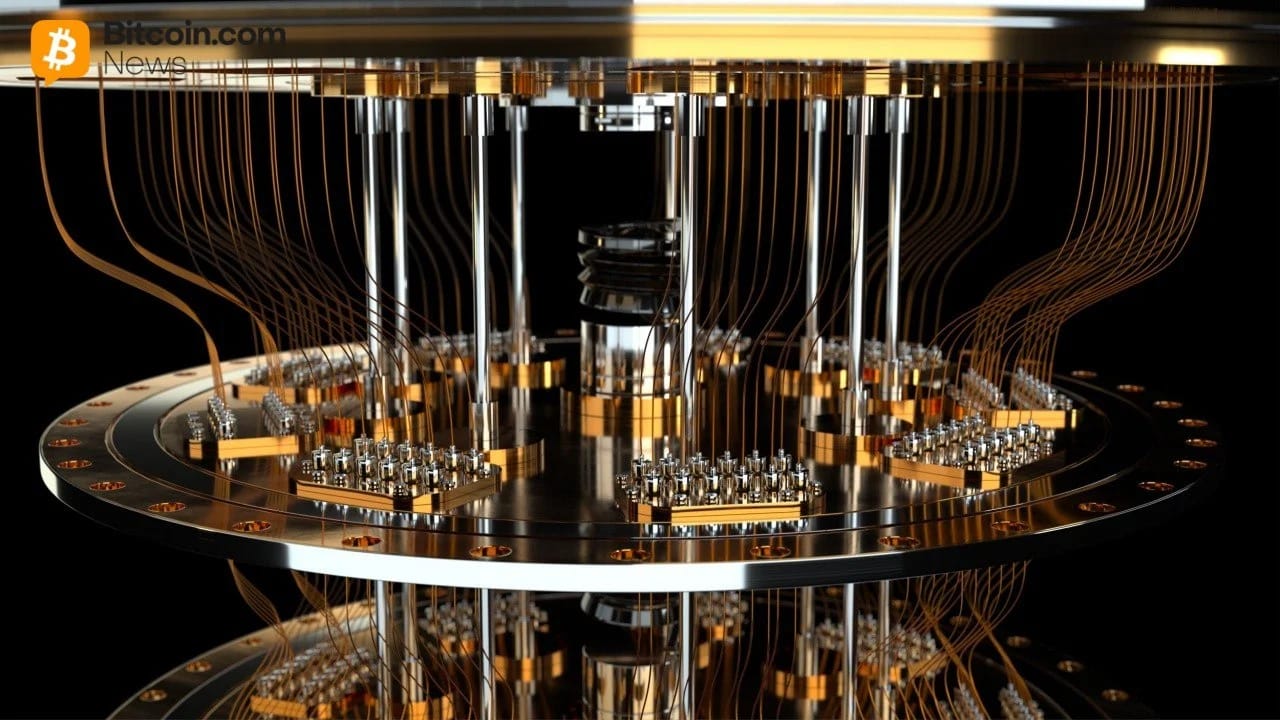 Nic Carter Raises Concerns on Bitcoin’s Quantum Vulnerability: Q-Day to Arrive by 2035In a new article, Nic Carter, a Bitcoin proponent and partner at Castle Island Ventures, raises concerns about Bitcoin’s quantum vulnerability, especially with the development of a cryptographically relevant quantum computer (CRQC) on the horizon. Carter believes the quantum threat is real and that the “Q-Day” will happen circa 2035, supporting his claim with the rapid increase in quantum computing capacity and soaring investments in CRQC technology. |
📊Market Insights

As “Wicked Problems” Arise, Firms That Adopt Quantum-Style Reasoning Might Gain a (Quantum) Competitive Advantage
Firms that face “wicked problems,” i.e., complex, interdependent strategic challenges, can gain a competitive advantage by adopting quantum-style reasoning on classical computers, for example using quantum annealing logic, quantum Bayesian networks and variational quantum feature-selection algorithms built entirely for classical infrastructure. The trend suggests that quantum-native thinking is entering enterprise decision-making earlier than many hardware roadmaps predicted.
📬 Stay Connected
While October focused on how quantum technology plugs into data centers, cloud networks, and HPC workflows, November spotlighted the massive capital commitments now flowing into the space—from national governments, supercomputing centers, and new quantum-focused funds.
Across the board:
Investment is rising sharply, with multi-hundred-million-dollar allocations from DOE, Japan, Qatar, and new private-sector funds.
Strategic partnerships are multiplying, from BTQ–QPerfect to IonQ–Heven AeroTech to NVIDIA’s expanding NVQLink ecosystem.
Long-term projections—and early warnings—are surfacing, as industry leaders anticipate industrially useful, fault-tolerant quantum machines within the 2030–2035 window.
Contact us at [email protected]
Follow BTQ for real-time updates and research